This film isn't on YouTube yet. Subscribe to catch it when it goes up.

The short answer
Your brain seems to predict what your own movements will feel like, then dim the result. In a robot experiment, people’s own touch felt more tickly as it fell out of step with their hand, up to about a fifth of a second. The authors think that’s because it no longer matched the brain’s prediction.
Try it now. Run your fingers along your own ribs.
You can feel your fingers, but you’re probably not squirming. Scientists have measured this, at least in the lab. In a 1999 study, people rated a touch they made themselves as significantly less tickly than the same touch from a robot.11 Blakemore, Frith & Wolpert, Journal of Cognitive Neuroscience, 1999 High
“Less tickly” is a weaker claim than the “nothing” in our video.22 Blakemore, Frith & Wolpert, Journal of Cognitive Neuroscience, 1999 Simplified We’ll come back to that. First, the explanation.
Your brain sees it coming
The explanation in these studies is prediction. When you move, your brain seems to work out what the movement should feel like and use that to turn the feeling down.
A 1998 brain-scanning study of six volunteers looked for signs of this.33 Blakemore, Wolpert & Frith, Nature Neuroscience, 1998 Good The brain’s touch areas were less active when people made a touch themselves than when the touch came from someone else. In those areas, the drop came with any movement, even one that touched nothing. The pattern specific to touch showed up in the cerebellum, where activity fell during a movement that produced a touch, but not during a movement that didn’t. The authors proposed that the cerebellum is involved in predicting what a movement will feel like, and in supplying the signal that cancels the response.
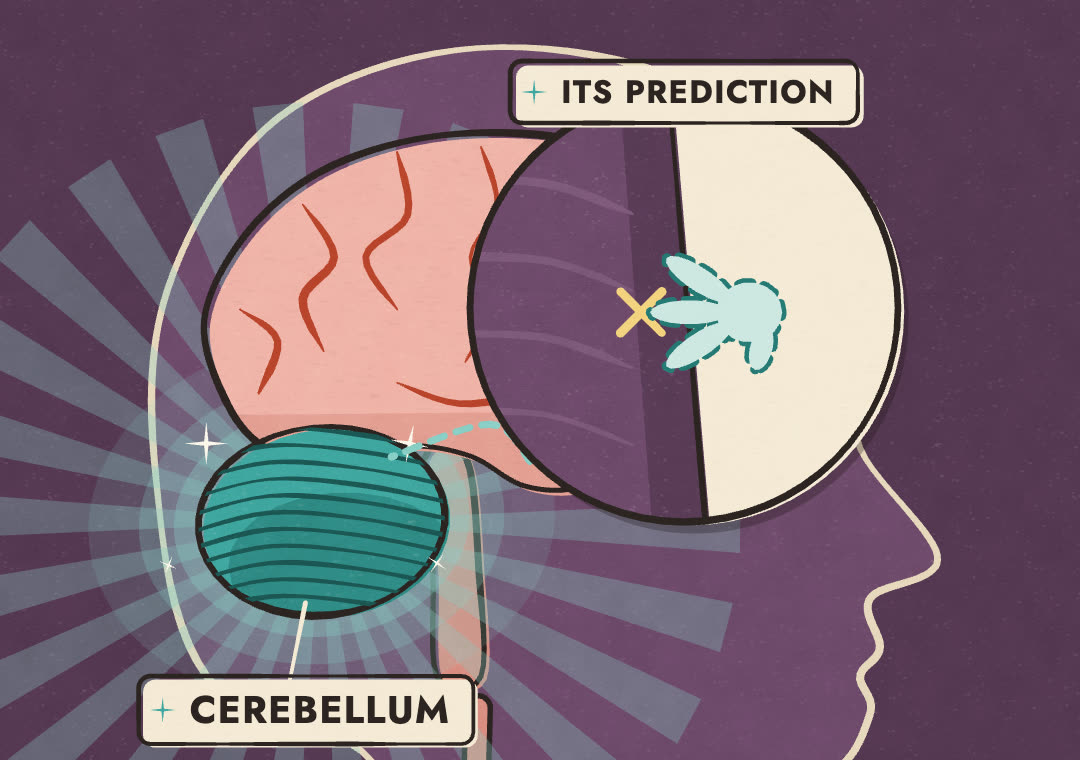
A 1999 analysis of what appear to be the same scans put part of that idea to a statistical test.44 Blakemore, Wolpert & Frith, NeuroImage, 1999 Good When people touched themselves, activity in the thalamus and the brain’s touch areas rose and fell with activity in the cerebellum. When the touch came from outside, it didn’t. That’s a pattern in brain scans from a small group. The authors offer it as support for their proposal, and we read it the same way.
The robot test
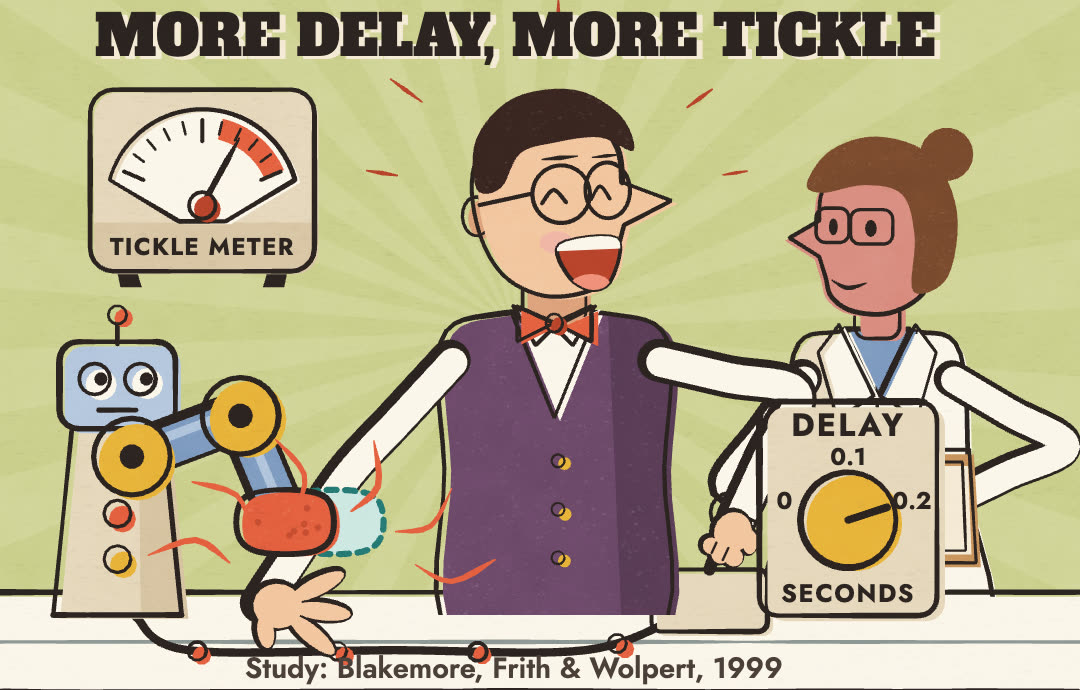
The experiment in our video comes from the same researchers, published in 1999.55 Blakemore, Frith & Wolpert, Journal of Cognitive Neuroscience, 1999 High Sixteen volunteers sat with their eyes shut. Each one held a small object in their left hand and moved it back and forth. Two connected robots copied that movement onto a piece of foam on their right palm.
With no delay, the foam moved as the hand moved. In other trials, the researchers added a delay of 100, 200, or 300 milliseconds, without telling anyone. In others, a robot moved the foam by itself while the volunteer’s left hand stayed still. The order was shuffled. Volunteers rated how each touch felt from 0 to 10 on a list of words that included “tickly.” The researchers described the study as being about touch in general, so people wouldn’t go in thinking about tickling.
Ratings rose significantly as the delay grew from 0 to 200 milliseconds, then leveled off.66 Blakemore, Frith & Wolpert, Journal of Cognitive Neuroscience, 1999 High Ratings at 200 milliseconds, at 300 milliseconds, and for the robot’s own touch weren’t significantly different. By about a fifth of a second, the touch from people’s own movement rated about the same as a touch the robot made alone.
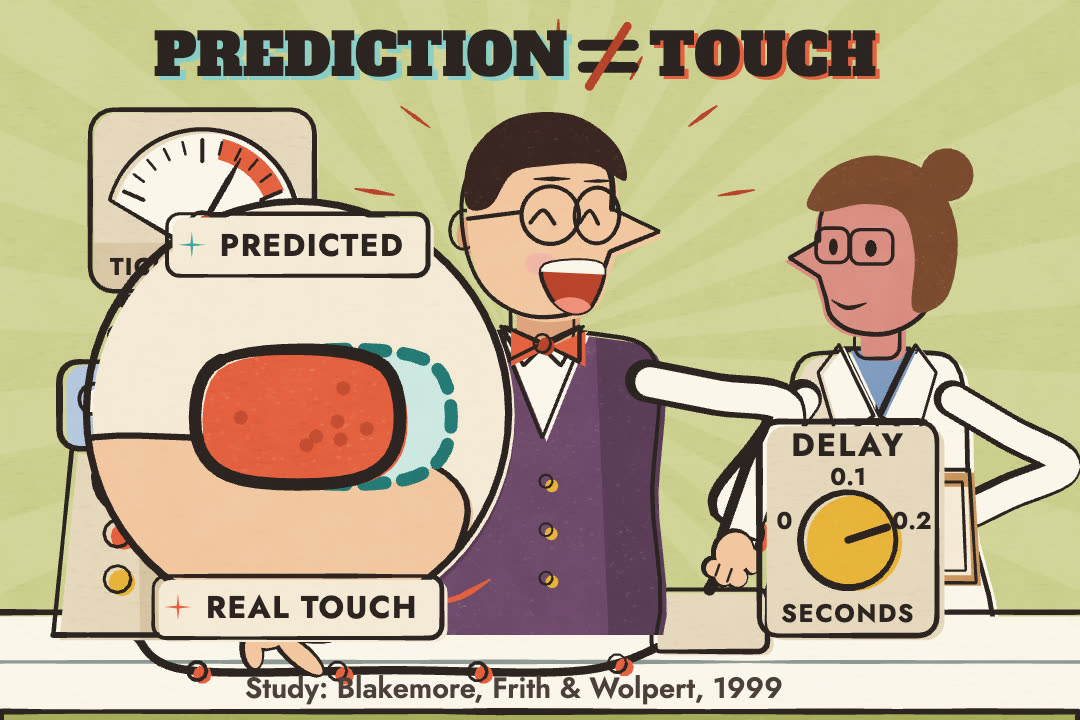
The strangest detail is how small that gap is. Only two of the 16 volunteers reported noticing any delay, and the other 14 said they were unaware of it.77 Blakemore, Frith & Wolpert, Journal of Cognitive Neuroscience, 1999 High The authors say this suggests the brain’s prediction is sensitive to small changes, even ones people aren’t aware of.
Direction mattered too. When volunteers moved their left hand along a line 30, 60, or 90 degrees off the foam’s path, ratings climbed again, though not at every step.88 Blakemore, Frith & Wolpert, Journal of Cognitive Neuroscience, 1999 High Unlike the delays, this was a mismatch people knew about.
A 2001 brain-scanning study used a similar robot setup and found that activity in part of the cerebellum rose with the delay.99 Blakemore, Frith & Wolpert, NeuroReport, 2001 Good The authors say this suggests the cerebellum is involved in signaling the gap between the predicted touch and the actual one.
What “surprise” means here
Our video says tickling is about surprise.1010 Blakemore, Frith & Wolpert, Journal of Cognitive Neuroscience, 1999 Simplified That’s our loosest line, so here’s what it can and can’t mean.
In everyday speech, a surprise is something you didn’t see coming. The robot study was set up to rule that out.1111 Blakemore, Frith & Wolpert, Journal of Cognitive Neuroscience, 1999 Good The robot’s own touch was highly predictable, and it still rated as more tickly than a touch people made themselves. The authors argue the delayed touch was predictable too, because the left hand’s movement fully determined it, and they think a mismatch explains the results better than predictability does.
So in this study, “surprise” has to mean a mismatch between the touch you feel and the touch your brain predicted from your own movement. A touch can be fully determined by your own movement and still produce that mismatch. The authors propose that how much a touch gets dimmed depends on the size of that error.1212 Blakemore, Frith & Wolpert, Journal of Cognitive Neuroscience, 1999 Good
Why a brain would do this
The authors offer some suggestions, and the study didn’t test them. Touch from the outside world usually matters more than touch you cause yourself, so ignoring your own movements could help unexpected touch stand out.1313 Blakemore, Frith & Wolpert, Journal of Cognitive Neuroscience, 1999 Good They also suggest this could keep you from laughing at your own touch. And they argue that canceling your own touch completely may not make sense, because you’d go numb whenever you moved. That’s one more reason not to take “nothing” literally.
What we simplified, and what’s still unsure
- “Nothing” and “you can’t” are too strong. The studies measured less tickly. They didn’t find that the feeling disappears.2 The film’s meter has no numbers, and its needle isn’t a measurement.
- “It isn’t really about touch” overstates it. Tickling still needs a touch. The studies show that the same touch can feel different depending on what causes it.10
- The film states the mechanism as fact. “Predicts,” “blocking,” and “before it reaches you” are flat versions of what the authors propose from brain scans.1515 Blakemore, Wolpert & Frith, Nature Neuroscience, 1998 Simplified
- The film simplifies the lab. It shows a robot with a foam-tipped arm, wired to a box with a handle, and the real setup used two connected robot arms. Its man cracks up on screen, but the study recorded ratings, not laughter, and the real volunteers kept their eyes shut. The film’s dial stops at 0.2 seconds because that’s where the effect levels off.
- These are small lab studies. The delay result comes from 16 right-handed volunteers, ages 19 to 30, rating a piece of foam on their palm.5 Nobody tickled anyone’s ribs. The 1998 and 1999 brain-scan results come from just six volunteers, and the 1999 paper appears to reuse the 1998 scans.4
- Not every rating clearly followed the delay. The delay effect was clear in “tickly” ratings. Ratings for “intense” and “pleasant” showed a trend but no correlation with the delay, and the authors say that might be because those ratings varied more.1414 Blakemore, Frith & Wolpert, Journal of Cognitive Neuroscience, 1999 High
- Predictability isn’t fully settled. An earlier study claimed that more predictable touch felt less tickly, though it changed predictability only by having people open or shut their eyes.11
- We didn’t read every paper equally. We read the 1998 and 1999 papers in full, and only the abstract of the 2001 study. Each row below says how far we read.
What we checked
Every fact in this post, where it came from, and how sure we are. Here's what each level means.
| # | What we said | Where it comes from | Data from | Checked | How sure |
|---|---|---|---|---|---|
| 1 | People rated a touch they made themselves as significantly less tickly than the same touch from a robot. | Blakemore, Frith & Wolpert, Journal of Cognitive Neuroscience, 1999. Free abstract | Published 1999 | Oct 31, 2026 | High The paper reports this from its own ratings. We read the whole paper. |
| 2 | “Nothing, right?” and “you can’t tickle yourself.” (our video) | Blakemore, Frith & Wolpert, Journal of Cognitive Neuroscience, 1999 | Published 1999 | Oct 31, 2026 | Simplified People rated their own touch as less tickly. The paper reports ranks, not raw scores, so it doesn’t say how close to zero those ratings were. We read the whole paper. |
| 3 | The brain’s touch areas were less active for self-made touch than for outside touch, and the authors proposed that the cerebellum is involved in predicting what a movement will feel like. | Blakemore, Wolpert & Frith, Nature Neuroscience, 1998. Free abstract | Published 1998 | Oct 31, 2026 | Good Brain scans of six volunteers, and the prediction part is the authors’ proposal. We read the whole paper. |
| 4 | During self-made touch, activity in the thalamus and touch areas rose and fell with cerebellum activity. During outside touch, it didn’t. | Blakemore, Wolpert & Frith, NeuroImage, 1999. Free abstract. Full text from the author’s lab | Published 1999 | Oct 31, 2026 | Good A pattern in brain scans of six volunteers, offered as support for a proposal. The paper doesn’t say so outright, but its scans appear to be the 1998 study’s. We read the whole paper. |
| 5 | Sixteen right-handed volunteers, eyes shut, moved one robot with their left hand while a second robot moved foam on their right palm, with delays of 100, 200, or 300 ms. | Blakemore, Frith & Wolpert, Journal of Cognitive Neuroscience, 1999 | Published 1999 | Oct 31, 2026 | High From the paper’s methods. We read the whole paper. |
| 6 | Tickle ratings rose as the delay grew to 200 milliseconds, then leveled off. | Blakemore, Frith & Wolpert, Journal of Cognitive Neuroscience, 1999 | Published 1999 | Oct 31, 2026 | High The paper reports a significant rise from 0 to 200 ms, and no significant difference among 200 ms, 300 ms, and the robot’s own touch. The chart’s values are read off its Figure 3. We read the whole paper. |
| 7 | Only two of the 16 volunteers reported noticing any delay. | Blakemore, Frith & Wolpert, Journal of Cognitive Neuroscience, 1999 | Published 1999 | Oct 31, 2026 | High Reported in the paper. This is what people said afterward, not a separate test of whether they could detect a delay. We read the whole paper. |
| 8 | Making the hand’s path differ from the foam’s path also raised ratings, up to 90 degrees. Volunteers knew about this change. | Blakemore, Frith & Wolpert, Journal of Cognitive Neuroscience, 1999 | Published 1999 | Oct 31, 2026 | High The paper reports a significant rise from 0 to 90 degrees, with significant steps from 0 to 30 and from 60 to 90. We read the whole paper. |
| 9 | In a similar robot setup, activity in part of the cerebellum rose with the delay. | Blakemore, Frith & Wolpert, NeuroReport, 2001. Free abstract | Published 2001 | Oct 31, 2026 | Good Brain-scan evidence, and the authors word their reading as a suggestion. We read only the abstract. |
| 10 | “Tickling isn’t really about touch. It’s about surprise.” (our video) | Blakemore, Frith & Wolpert, Journal of Cognitive Neuroscience, 1999 | Published 1999 | Oct 31, 2026 | Simplified It holds only if “surprise” means a mismatch with your brain’s prediction. Tickling still needs a touch, and a predictable robot touch still rated as more tickly. We read the whole paper. |
| 11 | The robot’s touch was predictable and still rated as more tickly, so plain unpredictability doesn’t explain the result. | Blakemore, Frith & Wolpert, Journal of Cognitive Neuroscience, 1999 | Published 1999 | Oct 31, 2026 | Good This is the authors’ argument. An earlier study they cite claimed predictability does lower tickliness, with weaker controls. We read the whole paper. |
| 12 | How much a touch gets dimmed depends on the size of the error between the predicted and the actual feeling. | Blakemore, Frith & Wolpert, Journal of Cognitive Neuroscience, 1999 | Published 1999 | Oct 31, 2026 | Good The authors propose this as an explanation of their results. We read the whole paper. |
| 13 | Ignoring your own movements may help outside touch stand out and may keep you from laughing at your own touch, and canceling it completely may leave you numb when you move. | Blakemore, Frith & Wolpert, Journal of Cognitive Neuroscience, 1999 | Published 1999 | Oct 31, 2026 | Good From the paper’s discussion, where the authors reason about purpose. The study didn’t test it. We read the whole paper. |
| 14 | Ratings for “intense” and “pleasant” showed a trend with the delay, but no correlation. | Blakemore, Frith & Wolpert, Journal of Cognitive Neuroscience, 1999 | Published 1999 | Oct 31, 2026 | High Reported in the paper’s discussion. The authors say higher variance in those ratings might explain it. We read the whole paper. |
| 15 | “A part of your brain called the cerebellum predicts,” “your brain is blocking it,” and “it turns the feeling down before it reaches you.” (our video) | Blakemore, Wolpert & Frith, Nature Neuroscience, 1998 | Published 1998 | Oct 31, 2026 | Simplified The authors propose this from brain scans, and “before it reaches you” is everyday wording for lower activity in the touch areas. We read the whole paper. |