This film isn't on YouTube yet. Subscribe to catch it when it goes up.
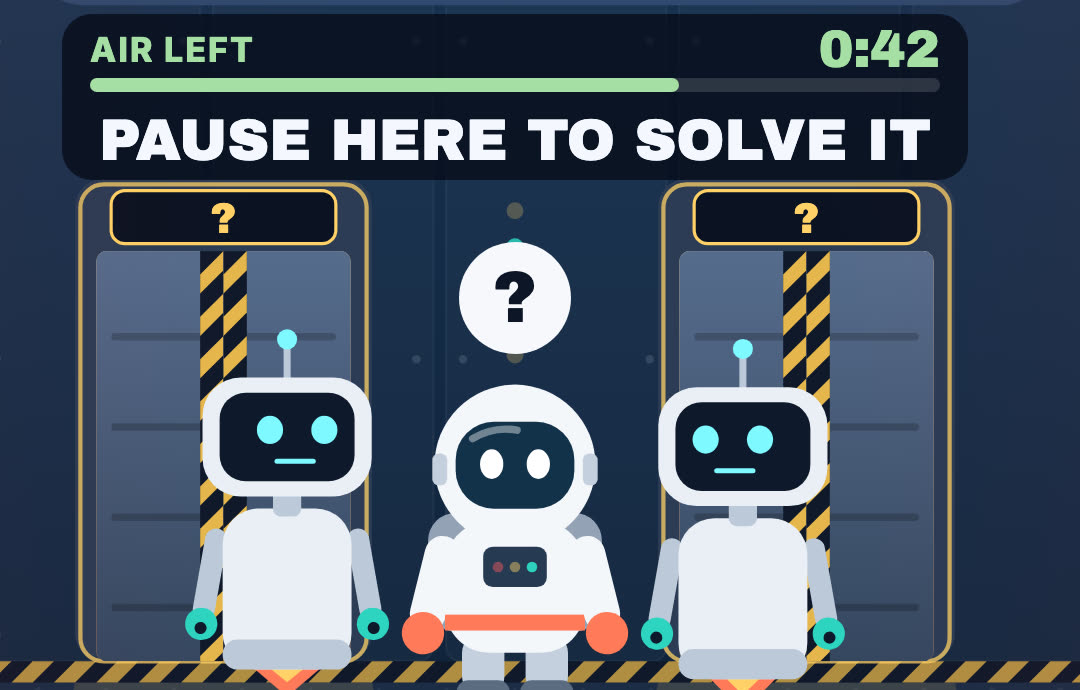
You’ve got one minute of air left. There are two doors. One leads to the escape pod, and the other opens into empty space.
Two robots guard the doors. One always tells the truth, and the other always lies. You can’t tell which is which, but both robots know which door is safe, and each knows how the other one behaves. You get one question, for one robot.
What do you ask?
Try to solve it before you open the answer.
Show the answer
Ask either robot this: “If I asked the other robot which door is safe, which door would it point to?” Then take the other door.
Why it works
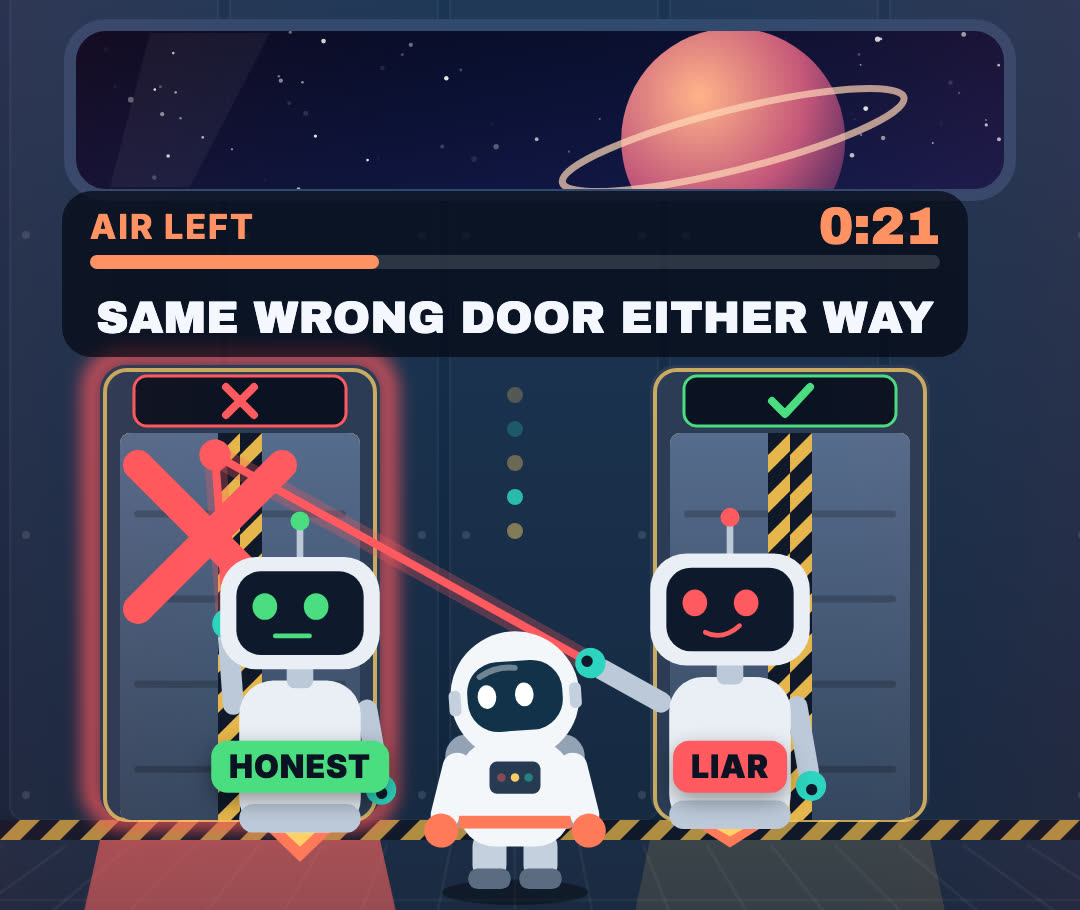
Your question passes through both robots, so the lie ends up in the answer exactly once, whichever robot you ask.
- If you ask the honest robot, it knows the liar would point to the wrong door, so it truthfully tells you that.
- If you ask the liar, it knows the honest robot would point to the safe door, so it lies and points to the wrong door too.
Either way, you get the wrong door.
Every possible case
There are only four possible setups, and we checked all of them.11 Our own check of all four setups, shown in the table above. Certain
| The safe door is | You ask | The other robot would point to | So your robot says | The door you take |
|---|---|---|---|---|
| Left | The honest robot | Right | Right | Left, which is safe |
| Left | The liar | Left | Right | Left, which is safe |
| Right | The honest robot | Left | Left | Right, which is safe |
| Right | The liar | Right | Left | Right, which is safe |
Another question that works
You can also ask a robot about itself: “If I asked you whether the left door is safe, would you say yes?” A yes means the left door is safe, and a no means it isn’t.22 Knights and Knaves, Wikipedia Certain The honest robot simply tells the truth. The liar has to lie about its own lie, and the two lies cancel out.
Where the puzzle comes from
This puzzle is far older than our spaceship. Puzzles about truth-tellers and liars are known as “knights and knaves”, a name Raymond Smullyan coined in his 1978 book What Is the Name of This Book?33 Knights and Knaves, Wikipedia Good Wikipedia also describes a version the philosopher Nelson Goodman published anonymously in the Boston Post in 1931, and says a scene in the 1986 film Labyrinth helped popularize the two-door form.
What we made up, and what the answer depends on
The spaceship, the robots, and the minute of air are fiction, so there’s nothing there to check. The answer depends on two assumptions. Each robot has to know which door is safe, and each has to know how the other one answers. Without the second, the honest robot couldn’t tell you what the liar would say, and the trick falls apart.
What we checked
Every fact in this post, where it came from, and how sure we are. Here's what each level means.
| # | What we said | Where it comes from | Data from | Checked | How sure |
|---|---|---|---|---|---|
| 1 | Whichever robot you ask, the question points to the wrong door, so the other door is safe. | Our own check of all four setups, shown in the table above. | Logic, not data | Oct 31, 2026 | Certain It holds as long as each robot knows which door is safe and how the other one answers. |
| 2 | Asking a robot what it would say about a door gets the correct answer about that door from either robot. | Knights and Knaves, Wikipedia, plus our own check of both robots. | Logic, not data | Oct 31, 2026 | Certain We worked through both robots ourselves. It holds as long as each robot knows which door is safe. |
| 3 | Raymond Smullyan named knights and knaves in 1978, Nelson Goodman published a version in 1931, and a scene in the 1986 film Labyrinth helped popularize the two-door form. | Knights and Knaves, Wikipedia | 1931 to 1986 | Oct 31, 2026 | Good This is Wikipedia’s account, and its section on Labyrinth is marked as needing references. We didn’t check the book, the newspaper, or the film ourselves. |